Umrah is a beautiful and spiritual journey, but it can also be physically demanding.
You may be walking much more than usual, spending time in crowded places, adjusting to a different climate, sleeping less than normal and following a busy schedule between Makkah and Madinah. Sometimes, despite your best preparation, you may simply become unwell.
So, what should you do if you become sick during Umrah?
The first thing to remember is that you do not have to push yourself through your illness just because you have travelled so far. Looking after your health is important. Saudi Arabia has healthcare facilities and services available for pilgrims, and the Ministry of Health provides a dedicated 937 health service for medical advice and assistance.
In this guide, we explain what to do if you become sick during Umrah, when to seek medical help, how to prepare before travelling and some simple ways to protect your health during your pilgrimage.
Can You Get Sick During Umrah?
Yes. Becoming unwell during Umrah can happen to anyone.
The combination of walking, crowds, heat, changes in routine and travel fatigue can put extra pressure on your body.
Some common problems pilgrims may experience include:
- Dehydration
- Headaches
- Fatigue
- Heat exhaustion
- Stomach upset
- Vomiting or diarrhoea
- Coughs and respiratory infections
- Muscle and foot pain
- Minor injuries
- Fever
- Existing medical conditions becoming harder to manage
Saudi Arabia's Ministry of Health specifically highlights heat-related illness, dehydration, respiratory infections and muscle and foot fatigue as health concerns for pilgrims.
This does not mean you should be worried about every symptom. It simply means that listening to your body is an important part of preparing for Umrah.
What Should You Do If You Feel Sick During Umrah?
If you start feeling unwell, don't immediately assume you have to continue.
Stop and assess how you are feeling.
If you are tired, dizzy, unusually weak or experiencing symptoms that are getting worse, find somewhere safe to sit or rest.
If possible:
- Move away from direct sunlight.
- Sit somewhere cool and safe.
- Drink fluids if you are able to do so.
- Rest instead of continuing to walk.
- Tell someone travelling with you that you are unwell.
- Contact a healthcare professional if your symptoms continue or become concerning.
Saudi Arabia's Ministry of Health advises pilgrims to rest, stay hydrated and avoid excessive heat and direct sun exposure.
Sometimes the best thing you can do is simply stop for a while.
You do not need to prove that you can keep walking when your body is telling you to rest.
When Should You Get Medical Help?
Not every headache or tired feeling requires an ambulance.
However, you should seek medical attention if you are significantly unwell, your symptoms are worsening or you are concerned about your condition.
For non-emergency health concerns, Saudi Arabia's Ministry of Health provides 937, which offers medical advice and consultation to pilgrims. The service operates around the clock and supports pilgrims in multiple languages.
For example, you may consider seeking medical advice if you have:
- Persistent vomiting
- Significant diarrhoea
- A high or persistent fever
- Severe dizziness
- Difficulty keeping fluids down
- Unusual weakness
- Symptoms that continue despite rest
- Worsening symptoms from an existing medical condition
- Any other health concern that you are unsure about
If you are seriously unwell or the situation appears life-threatening, seek emergency medical assistance rather than waiting for symptoms to improve.
What Is the Saudi Arabia Health Number for Pilgrims?
One of the most useful numbers to save before travelling is:
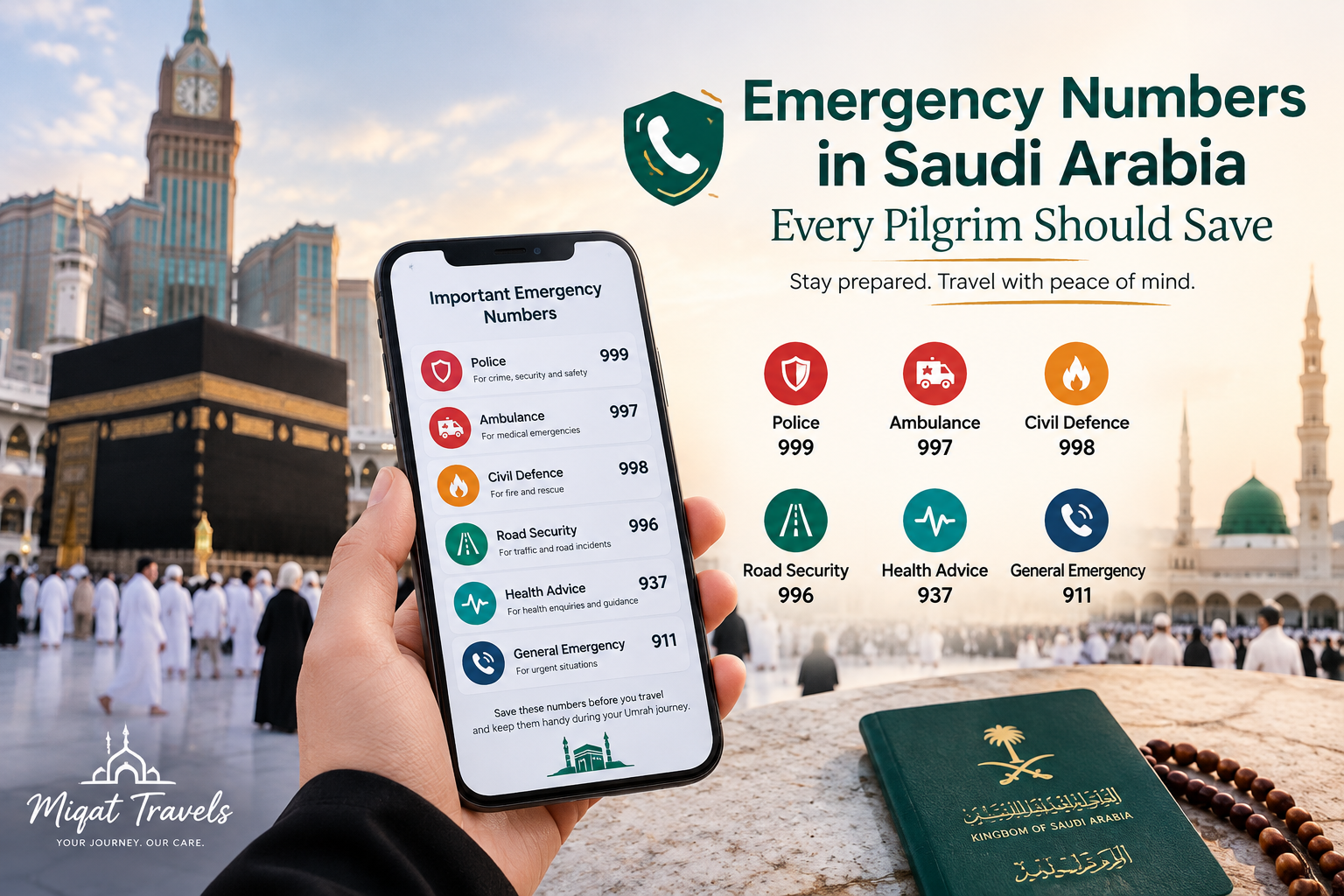
937 — Saudi Ministry of Health
The Ministry of Health's 937 service provides medical advice and consultations for pilgrims and can assist with health-related enquiries and urgent notifications. The service is available 24/7 and has multilingual support.
The Ministry has stated that the service supports languages including Arabic, English, French, Urdu, Indonesian, Farsi and Turkish.
This can be particularly helpful if you are unsure whether you need to visit a healthcare facility.
Save it in your phone as:
Saudi Health — 937
What If It Is a Medical Emergency?
If you are experiencing a serious medical emergency, do not wait for the problem to resolve by itself.
Saudi Arabia's Ministry of Health advises pilgrims requiring emergency medical care to seek the emergency department of the nearest hospital, and its guidance has also identified 911 as an emergency option.
You can also save:
997 — Saudi Red Crescent Ambulance
Having the numbers saved before your Umrah journey means you don't have to search for them while dealing with a stressful situation.
For more emergency contacts, see our guide:
Emergency Numbers in Saudi Arabia Every Pilgrim Should Save Before Umrah
What If You Become Sick Inside Masjid al-Haram?
If you start feeling unwell while you are at or around Masjid al-Haram, don't feel that you have to continue your journey simply because you have already started.
If you feel dizzy, extremely weak or unwell:
Stop. Rest. Tell someone. Get help if necessary.
If you are travelling with family, let them know immediately.
If you are alone, ask an appropriate member of staff or nearby authority for assistance rather than trying to walk a long distance while feeling unwell.
The important thing is not to ignore serious symptoms because you are worried about missing part of your planned schedule.
Your health matters.
What If You Are Too Sick to Complete Your Umrah?
This is one of the concerns some pilgrims have before travelling.
You may have planned every detail of your trip and imagined completing your Umrah without interruption. Then you wake up feeling unwell.
Don't panic.
From a health perspective, you should not force yourself to continue strenuous physical activity when you are seriously unwell.
If you become sick, speak with an appropriately qualified scholar or religious authority regarding the religious aspects of your particular situation, especially if you have already entered Ihram or started the rites.
For medical decisions, speak with a healthcare professional.
This distinction is important: a doctor can advise you about your physical condition, while a qualified religious scholar can advise you about the requirements and rulings relating to your specific Umrah circumstances.
Dehydration During Umrah
Dehydration is something pilgrims should take seriously.
Walking for long periods, sweating, hot weather, vomiting or diarrhoea can all contribute to dehydration.
Saudi Arabia's Ministry of Health lists symptoms that can include:
- Extreme thirst
- Tiredness
- Dizziness
- Dark yellow urine
- Dry mouth, lips or eyes
- Urinating less than usual
One simple mistake is waiting until you feel extremely thirsty before drinking.
The Ministry of Health advises pilgrims to drink sufficient fluids and not wait until they are thirsty, particularly during hot conditions.
At the same time, avoid forcing excessive amounts of water in a short period. Hydration should be sensible and appropriate to your individual health needs.
If you have a medical condition that affects how much fluid you should drink, follow your doctor's advice.
What If You Feel Dizzy or Overheated?
Heat can make a pilgrim feel unwell surprisingly quickly.
The Saudi Ministry of Health advises pilgrims to avoid direct sun exposure, rest, drink fluids and take precautions against heat stress.
If someone is showing signs of heat exhaustion, Ministry of Health first-aid guidance includes moving the person to a cool place, loosening clothing, cooling the body and encouraging fluids when appropriate. Medical intervention is advised if symptoms are severe, vomiting occurs or symptoms persist.
So if you start experiencing:
- Heavy sweating
- Dizziness
- Headache
- Nausea
- Weakness
- Feeling faint
- Muscle cramps
don't simply tell yourself, "I only have a little more walking to do."
Stop and take care of yourself.
If symptoms are severe or don't improve, seek medical attention.
What If You Have a Cold or Cough?
Respiratory symptoms can be particularly noticeable during pilgrimage because you are around large numbers of people from different countries.
If you develop a cough, sore throat, fever or other respiratory symptoms, rest and monitor how you feel.
Basic precautions can also help protect people around you.
Saudi Arabia's Ministry of Health recommends measures such as good hand hygiene and wearing a mask in crowded settings as part of infection-prevention guidance for pilgrims.
Consider carrying:
- Hand sanitiser
- Tissues
- A suitable mask
- Any regular medication you need
And if you are significantly unwell, seek medical advice.
What If You Have Diarrhoea or Vomiting?
Stomach problems can quickly become more serious if they lead to dehydration.
If you experience vomiting or diarrhoea:
- Rest
- Take fluids in appropriate amounts if you can
- Avoid strenuous walking
- Monitor your symptoms
- Seek medical advice if symptoms are severe, persistent or you cannot keep fluids down
The Ministry of Health identifies vomiting and diarrhoea as factors that can increase the risk of dehydration among pilgrims.
If symptoms are severe, don't wait until you become extremely weak before asking for help.
What If You Already Have a Medical Condition?
If you have a chronic condition, preparation should begin before your flight.
Saudi Arabia's Ministry of Health advises pilgrims with ongoing medical needs to bring sufficient medication and a detailed medical report showing their conditions, medications and doses.
Before travelling, consider speaking with your doctor about your trip and make sure you understand how to manage your medication while travelling.
Keep your medicines in their original packaging where appropriate and carry the information you may need about them.
It can also be helpful to have a written list containing:
Medical condition Medication name Dose Allergies Emergency contact
If you have diabetes, asthma, heart disease, kidney disease or another condition requiring regular treatment, don't assume that you can simply manage without your usual routine while travelling.
Don't Pack Only for the Pilgrimage — Pack for Your Health
A small personal medical kit can be extremely useful.
Depending on your personal needs, your travel health kit might include:
- Regular prescription medication
- Copies of prescriptions
- Medical information
- Basic wound-care supplies
- Hand sanitiser
- Masks
- Thermometer
- Any doctor-approved medicines you normally use
- Oral rehydration products if appropriate for you
Saudi Arabia's Ministry of Health specifically recommends that pilgrims prepare a medical bag and bring sufficient medication for existing conditions.
However, avoid taking medicines simply because someone else recommends them. If you have a medical condition or take regular medication, follow advice from your healthcare professional.
Rest Is Part of Your Umrah Preparation
One of the easiest mistakes to make is planning every minute of your trip.
Makkah.
Madinah.
Tawaf.
Sa'i.
Ziyarat.
Shopping.
Restaurants.
Family visits.
Then another early morning.
Your body may eventually say: enough.
Don't underestimate the value of sleep and rest.
You don't have to spend every waking hour outside your hotel.
A quiet afternoon resting in your room may be exactly what you need to have enough energy for the next part of your journey.
Don't Try to Keep Up With Everyone
If you are travelling with family or friends, remember that everyone's physical ability is different.
One person may be able to walk for hours without difficulty while another may need regular breaks.
This is particularly important when travelling with:
- Elderly parents
- Young children
- People with disabilities
- People with chronic health conditions
- Anyone recovering from illness
Plan your day around the needs of the person who requires the most support.
There is no prize for being the most exhausted pilgrim.
What Should You Tell Your Travel Companions?
Before leaving your hotel, make sure at least one person knows:
- Where you are staying
- Your mobile number
- Any important medical conditions
- Your regular medication
- Your emergency contact
- Your country's embassy or consulate details
If you are travelling with an elderly family member, consider keeping their hotel information and emergency contact details in their pocket or bag.
This becomes especially useful if someone gets separated from the group.
Save Your Hotel Details
If you become sick, tired or confused, knowing your hotel location can make everything easier.
Before going out, save:
Hotel name Hotel address Hotel phone number Map location
Take a screenshot so that you can access the information even if your internet connection is unreliable.
If you are staying in a large hotel complex or near a busy area, also take a photograph of the hotel entrance.
It sounds like a small thing, but when you are tired or unwell, small preparations can be incredibly helpful.
Don't Be Embarrassed to Ask for Help
Some pilgrims hesitate to ask for assistance because they don't want to inconvenience their family or because they feel they should be able to manage.
Please don't wait until a minor problem becomes a serious one.
If you are feeling unwell, tell someone.
If you need to sit down, sit down.
If you need medical advice, seek it.
If you need to change your plans for the day, change them.
Your Umrah journey does not have to be physically perfect to be meaningful.
A Simple "I'm Feeling Sick" Plan
Before your Umrah trip, save this simple plan:
Step 1 — Stop
Don't keep walking if you feel seriously unwell.
Step 2 — Find a safe place
Move away from direct sun, heavy crowds or unsafe areas.
Step 3 — Tell someone
Let your family member, travel companion or group leader know.
Step 4 — Assess the situation
If you have a minor concern, rest and monitor your symptoms.
Step 5 — Get medical advice
For health advice, contact 937.
Step 6 — Emergency?
If it is a serious emergency, seek emergency medical assistance immediately.
Umrah Health Checklist Before You Fly
Before travelling to Saudi Arabia, take a few minutes to prepare.
Before leaving home:
☐ Speak with your doctor if you have a medical condition ☐ Make sure you have enough regular medication ☐ Keep medication information with you ☐ Carry relevant medical records ☐ Save 937 in your phone ☐ Save 997 for ambulance assistance ☐ Save 911 for emergency assistance ☐ Save your hotel details ☐ Carry a charged phone ☐ Pack a power bank ☐ Take suitable clothing for the conditions ☐ Pack basic health supplies ☐ Know the emergency contact for your travel companions
Saudi Arabia's Ministry of Health also recommends completing required vaccinations and taking appropriate health precautions before travelling for pilgrimage. Current requirements can change, so check the Ministry's latest Umrah health requirements before your departure.
One More Important Thing: Don't Ignore Your Body
Umrah is a spiritual journey, and it is natural to want to make the most of every moment.
But sometimes the most sensible thing you can do is rest.
If your body needs a break, give it one.
If you are sick, seek appropriate medical advice.
If you are exhausted, slow down.
If you are travelling with an elderly parent or someone with a health condition, give them the extra time they need.
Preparing for Umrah isn't only about what you pack in your suitcase.
It is also about knowing when to rest, when to ask for help and where to get medical support.